1,2,3 test…(3)

June 26th, 2011

I found the time to go to Leipzig and use the [sublabs] oscilloscope on my [Diskokugel] circuit. Actually Nobody did that, assisted by Christian. It took a while to get it to work and the result was both satisfying and not satisfying. Because there was nothing to see. The crackle we hear when switching a speaker on and of did not show on the oscilloscope, which means the circuit works perfectly, and leaves us clueless as to the source of the problem. I did some more experiments but still have no idea.

Well, I might just leave it at that. Since the crackle is only really a problem when switching extremely fast or when a pure sine is used. I need to get this ball done now…

nothing to see here...

Keep it moving

June 21st, 2011

My DJ-Blog is getting dusted, so I decided to move it here. That won’t change much in the sense of missing content, but there is one less Blog to nurture ;)

However, soon there will be a “Download” section for my mixes and other stuff, such as puredata patches etc. I’ll keep you posted.

1,2,3 test…(2)

June 21st, 2011

I’ve been quite busy in the last weeks:

I presented my project at the [PD user group] in Berlin and got some interesting feedback. They would like to exhibit the Diskokugel or an installation based on it at the final party of this years [pd-con]. I feel honored but I have no idea if I can actually make it until then. Money is also an issue here. Having all the circuit boards made will cost…

I solved half of my clicking problem by getting the synchronization with the sound phase to work. Still, clicking occurs and since there was no oscilloscope at hand, I recorded it to make sure it’s not some kind of acoustic illusion due to differences in speaker loudness. The waveform clearly shows a distortion when the speaker is activated. When it’s turned off, something produces a sudden click and then the speaker swings out.

I will meet with Nobody and Christian (god praise his patience!) at the [sublab] this weekend and we will check the whole setup with an oscilloscope. I hope that we can fix this easily.

The noise occurring when a speaker is activated

When the speaker is turned of, something gives it an extra push.

1,2,3 test… (1)

May 5th, 2011

Today I did the first test run with one of the soldered boards and the Arduino. After some adjusting it works but I am not quite satisfied.

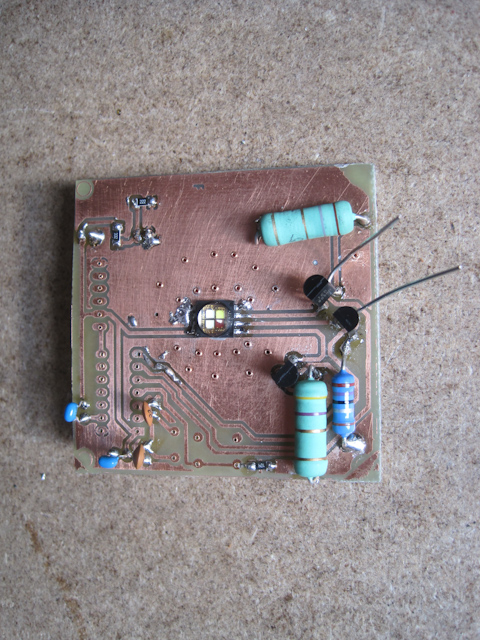
On the picture below you can see the setup: 8 speakers, attached to the switching board. Between the switching board and the Arduino is a board that converts the Arduinos signals (0/+5V) to the current level used by the switchboard (+/-5V). This converter board also houses a TL072 for pre-amplification and an LM311 to detect the audio signal’s null phase. This is necessary to prevent the speakers from clicking when switched on and of. And it doesn’t work jet. Why, I’ll have jet to find out…

Speakers, switchboard and Arduino connected. To the right is a voltage divider, converting 12V to +/-6V and GND

Burning a new bootloader into my Arduino Duemilanove [solved]

April 27th, 2011

[UPDATE]

I finally made it happen!!!!

After two days of suffering I found a thorough explanation, how to burn the Arduino bootloader on an Atmega328. This is the solution.

The 'self programming' Arduino

[/UPDATE]

I wanted to start testing the freshly soldered boards for the Diskokugel when I had to discover, I had made a big mistake simply using the Atmega328 of my Arduino in my LED lamp. It turned out to be not quite as simple to replace since the Atmega needs a special bootloader to work in the Arduino board.

There are several ways to burn that bootloader into the chip. The easiest would be having an Arduino and programming it to do it. But since mine was without working chip, I had to look for other solutions. I found one that uses the FT232 on the board to program the Arduino itsself without an AVR writer. However, the solution programmed there is for Windows only. There apparently is a way to do it with a Mac but I wasted a whole day on trying to get it to work. It’s really tiring, installing package after package due to dependencies, having to compile it all, etc. I ended up compiling packages and, when I had finally done that, having forgot what other package I actually wanted to install in the first place.

I’ll try again tomorrow, taking the chip out of the lamp and putting it back into the Arduino. If the Arduino-as-AVRISP works, Ill simply burn me a stash of Arduinos…

Diskokugel Electronics

April 21st, 2011

Christian provided me with some sample circuit boards which I assembled the last days.  Christian already had soldered the smd parts in place . Considering my latest clumsy attempts with the icosahedron, this was a wise thing to do. It was still a lot of work to just get the ICs and transistors in place. Once done, I discovered a major flaw in our board design, since the connectors aren’t yet ready to cascade the things. Back to the drafting board…

However, now it’s done and I can run a test with 40 speakers!

Five boards to run tests. The smaller one is the first Christian assembled, the others are ready to be attached to the icosahedron.

Re: Diskokugel (icosahedron 2) [Updated]

April 8th, 2011

I can’t believe how much time this took. I tried to find someone to help me weld theicosahedron but whatever I tried, something always went wrong. So, finally, I did it by myself. The result is pretty ugly (compared with how it started) and I guess I’ll have to invest some money to have someone professional do this once it proves to be a working concept. Thank god I don’t rely on my soldering talent to survive…

Not pretty. But robust.

UPDATE:

I took a part of the frame and used some acrylic compound to attach some bodies to it. I am not quite satisfied with the looks of the compound. I’ll try black hot glue the next days. Another alternative could be silicone.

Then I started to solder shims to the points where the frame will be attached to the icosahedron. Lot of work. Lot of progress.

full view from above. You can see the icosahedron inside.
From the inside you can see the chrome bodies
another full view

(Deutsch) A little LED-Lamp

February 28th, 2011

Sorry, this entry is only available in Deutsch.

(Deutsch) Diskokugel Progress

January 23rd, 2011

PD Video Player with Sound

November 13th, 2010

I had the idea to build a kind of solid state video player using Linux and Puredata with an Arduino. The educated reader might ask “Why PD?” and, of course, is right. The simple answer is: Because I can and its easy.

I take the latter back. When I came up with this I had totally ignored, that Puredata/Gems Pix_Film object doesn’t play sound. This means, video and sound have to be played in separate players and then be synced. Some research in PDs list gave me an example I started working with and I was partially successful. Video and sound sync well with a [vline~] but with high resolutions the sound glitches. This can be reduced by trying different video codecs (motionjpg is supposed to work pretty well) but still I wasn’t able to play 1280×1024 videos without the sound dropping sometimes. I didn’t have this problem using the [pix_buffer] object, but this way the video is loaded into the RAM uncompressed, which takes up tons of space and limits the possible length of videos loaded/used. This was on my MacBook with 2x2GHz and an onboard Intel 9400m graphics card. I will try it on Linux in the next days, lets see, if it works better.

However, I expect no wonders and theres no sense in building a solid state video player that needs hardware this expensive (and energy intensive). I want to use one of these fit-pcs, loving their small design and power consumption. For them to work with videos of that resolution I need to use their hardware acceleration, which might prove difficult on Linux (I heard nothing good about the support of intels gma500) and even worse when relying on PD/Gem, which uses OpenGL to render video. So the plan now is to use a common video player like VLC or mplayer and remote control it via network/localhost. That should take care of the hardware acceleration and still make use of the serial interface and interaction possibilities of PD. Stay tuned…

This patch syncs video and audio